Fresh thinking: Collaborating on supply chain due diligence
Riverford Organic Farmers Ltd has been pioneering ethical food production for decades, delivering fresh, seasonal produce directly to customers while maintaining rigorous standards throughout their supply chain. Organic Herb Trading specialises in sourcing premium organic herbs and spices, working closely with growers around the world to bring quality ingredients to market.
The challenge
These two forward-thinking companies were both facing a common dilemma. Their procurement teams had been tasked with visiting and listening to suppliers and they needed the confidence and nuanced understanding to spot issues, assess their severity, and engage suppliers in meaningful, collaborative conversations about improvement.
Both companies wanted their teams to feel genuinely equipped to navigate the grey areas of human rights risks – to know when to be concerned, how to ask the right questions, and how to build relationships that foster positive change.
Our approach
We began where we always do – by digging right in! Through detailed conversations with both teams, we mapped their business structures, sourcing practices, and the specific challenges they’d already encountered in the field. Our aim was to understand their unique contexts and build something that would work for their people and their supply chains.
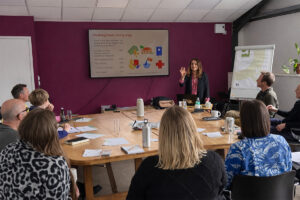
We developed an innovative collaborative training model that met everyone’s needs. Rather than working in silos, Riverford and Organic Herb Trading came together for a joint session at Riverford’s headquarters. This created a space where teams could learn not only from us, but from each other’s experiences and perspectives, including their very knowledgeable, on-the-ground teams, who joined virtually from overseas.
The full-day training was carefully structured to balance theoretical grounding with practical application. The core teams spent the morning exploring what human rights issues might look like in practice, developing their skills in recognition and identifying issues on the ground.
We then opened up for a broader session, sharing key insights with wider teams and senior leadership, and focusing on the crucial “so what” question – what to do when issues are identified.
Real impact
The results speak for themselves. Post-training feedback revealed a fundamental shift in how participants understood modern slavery, forced labour, and child labour risks. As one attendee put it:
Great day learning about human rights and where the risks lie within our supply chain, completely reshaped the way I think of modern slavery and forced & child labour.
The collaborative approach proved particularly valuable. Dale Robinson from Riverford noted that:
The joint element of it between Riverford and OHT was particularly enriching. It enabled great conversation and viewpoints we likely wouldn’t have discussed or considered if it was a single business participating.
The quality of facilitation was equally impactful. As Eileen Clarke from OHT reflected on Inherently Human’s Gabbi:
You’re an exceptional trainer – your experience is evident and you were professional and clear. It was striking to me how present you are in the room, listening and responding to participants, unfazed by moving between the wide range of contexts we talked about.
Participants praised the interactive nature of the training and the use of real-world examples. The session equipped them with practical tools for supplier visits, helping them shift focus from just checking produce quality to also identifying potential issues with worker conditions and environmental factors.
A safe space for learning
This project exemplifies what happens when a company shifts its focus beyond compliance-based training towards empowering their in-country staff. By creating a safe space for nuanced discussion and collaborative learning, we helped these teams develop the confidence to engage with suppliers and frame them as partners in improvement.
The joint training model also demonstrates the power of peer learning in the human rights space. When companies share challenges and solutions, everyone benefits – and ultimately, so do the workers in their supply chains.